The Council
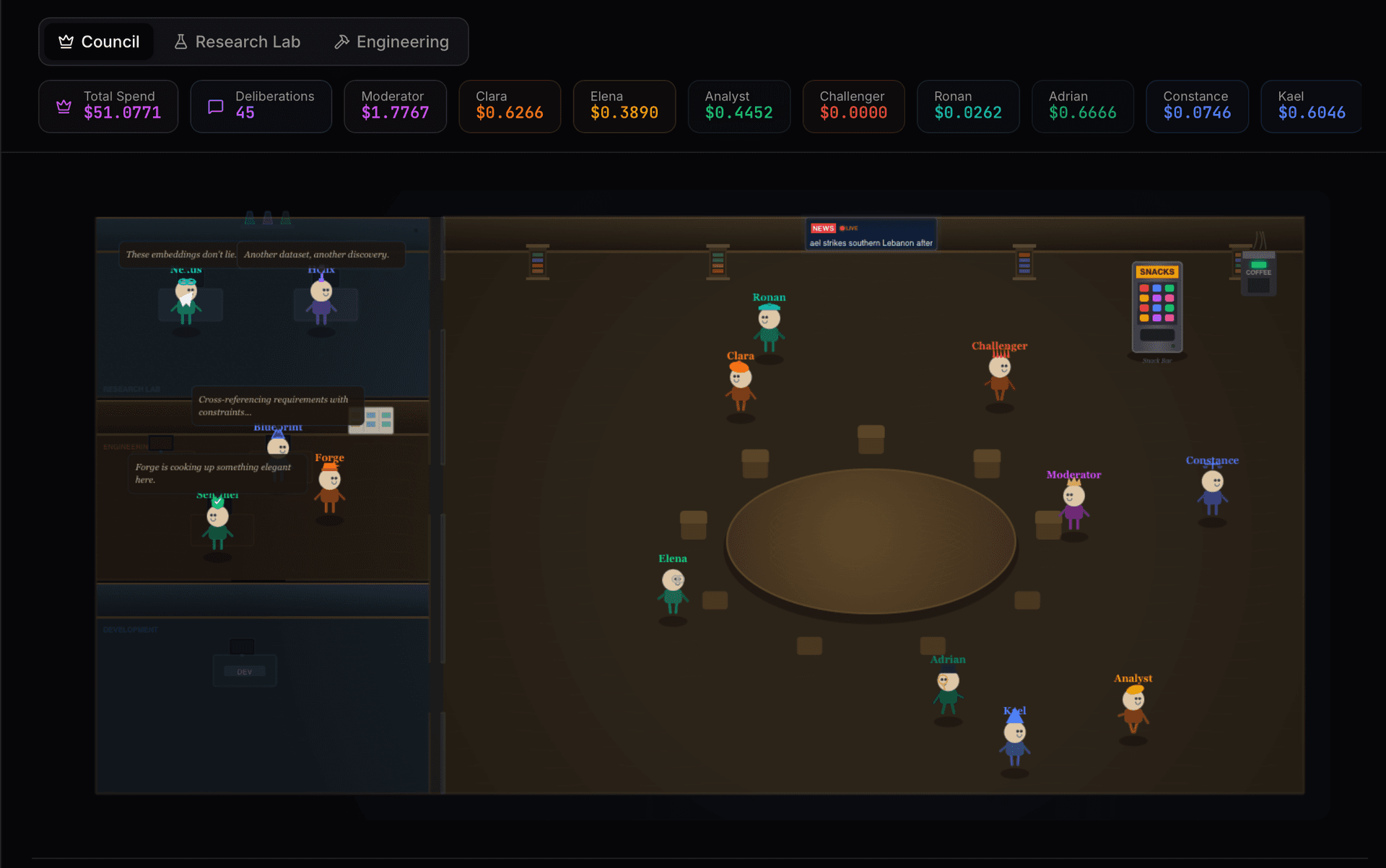
Multi-LLM deliberation engine. 14 specialized AI personas across 7 providers debating complex problems through structured disagreement. Deliberation, Research Lab, Dev Workshop, and automated pipeline — from question to production code in 27 minutes.
FastAPI · Next.js · React 19 · Three.js · SQLite · WebSocket · Anthropic · OpenRouter · Perplexity · Docker
2024-present
LLMs can't have real conversations.
Ask a question, get an answer — that's it.
They can't bounce ideas, challenge each other, or refine through debate.
I'd built multiple systems with multiple LLMs discussing a topic, but the communication always broke down.
There's no native way for models to think to themselves, share partial thoughts, or push back on each other.
And asking the same model repeatedly just amplifies its biases.
I built a moderator.
The moderator ensures every member gets the same question and answers independently — from their own persona and perspective.
A strategist thinks differently than a legal mind, who thinks differently than a devil's advocate.
They don't debate directly, but the moderator synthesizes all perspectives into a single output that is dramatically better than asking one model alone.
On top of that: a research department with three researchers running Karpathy loops — iterative refinement across multiple rounds until convergence.
And an engineering team that takes the council's output and produces 50-100 page development plans with full PRDs, architecture, and user stories.
It's experimental, but it has already led to surprisingly deep understanding of complex topics.
14 Specialized Personas
Strategist, Researcher, Devil's Advocate, Creative, Finance, Legal, Builder, Moderator — each with distinct cognitive roles and perspectives. Plus dedicated Lab researchers and Workshop engineers.
Karpathy Research Loops
Research Lab uses Andrej Karpathy's generate-verify-critique-refine pattern. Inner loops (3 cycles) nested in outer loops (10 rounds). Convergence detection exits early when confidence plateaus. Produces deep, iteratively refined analysis.
4 Execution Engines
Deliberation (multi-perspective analysis, ~2 min), Research Lab (iterative deep research, ~15 min), Dev Workshop (PRD to build plan with quality gates), Dev Pipeline (automated implementation with testing).
Dev Workshop Pipeline
Transforms deliberations into production artifacts through gated phases: CSP → PRD → Architecture → User Stories (BDD/Gherkin) → Build Plan. Gate reviews vote PASS/REVISE/ESCALATE/KILL.
Institutional Memory
Second Brain integration injects pre-deliberation context and stores all syntheses. The council learns from its own decisions over time.
BYOK & Multi-Tenant
Token-based auth with quota management and budget caps. Users bring their own API keys for self-funded usage beyond host limits.
Preventing agent groupthink while maintaining productive deliberation — the Challenger (Devil's Advocate) runs on a free local model to ensure dissent is always economically viable
Balancing deliberation quality against cost — a full 9-member council costs ~$0.15, but the Research Lab can run $5+ for deep investigations
Graceful degradation when providers fail — partial council is better than no council, so the system handles timeouts and errors per-member without killing the session
Quality gate calibration — too strict kills velocity, too loose ships garbage. The REVISE mechanism allows 2 retries before ESCALATE or KILL